
 Jason Leung, System Engineer - IoT and IT System Development Specialist
Time-Sensitive Networking (TSN) is not a single protocol, but rather a set of IEEE 802.1 standards that enhance standard Ethernet to provide deterministic data transmission over Ethernet networks. In essence, it turns “best-effort” Ethernet into a predictable, reliable, and time-synchronised network—crucial for applications where timing is everything.
TSN-Clock Synchronization
IEEE 802.1AS-2020 (often called gPTP – Generalised Precision Time Protocol) is the core timing and synchronisation standard for Time-Sensitive Networking (TSN). It provides sub-microsecond clock synchronisation across all devices on an Ethernet network, creating a single, precise timeline that every switch, controller, and sensor follows.
key differences at a glance between IEEE 1588(PTP) and IEEE 802.1AS-2020 (gPTP)
| Feature | IEEE 1588 (PTP) | IEEE 802.1AS-2020(gPTP) |
|---|---|---|
| Scope | General purpose time synchronization for a wide variety of applications and network types (telecom, power, etc.). | Specific profile for Time-Sensitive Networking (TSN), Audio-Video Bridging (AVB), industrial automation, and automotive Ethernet. |
| OSI Layer | Supports various layers (Layer 2, Layer 3/4, etc.) and underlying transport protocols like UDP. | Operates exclusively at Layer 2 (Ethernet data link layer), which enables better performance and lower jitter. |
| Network Path | Can operate over networks with non-PTP-aware switches between PTP devices. | Requires all bridges and end stations in the synchronization path to be “time-aware” (gPTP-capable) to ensure consistent performance. |
| Complexity | Offers many features and degrees of freedom in implementation, leading to potential configuration challenges. | Simplifies configuration by restricting options, using a streamlined Best Master Clock Algorithm (BMCA), and defining fewer clock types. |
| Clock Types | Defines Ordinary, Boundary, and End-to-End Transparent clocks. | Primarily uses two types of time-aware systems: end stations and bridges (which function similarly to transparent clocks with peer-to-peer delay measurement). |
| Time Domains | Can manage multiple, independent time domains simultaneously. | Includes features to support multiple time domains (e.g., a “working clock” and a global time base) within a single system for specific applications. |
| Applications | Used in diverse fields like telecommunications, power, and general industrial automation. | Primarily targeted at applications requiring very high precision in local networks, such as Audio/Video Bridging (AVB), industrial automation, automotive Ethernet, and aerospace systems. |
TSN-Traffic Scheduling and Shaping
Manages how different types of data traffic are prioritised and transmitted, ensuring that critical data experiences minimal delay.
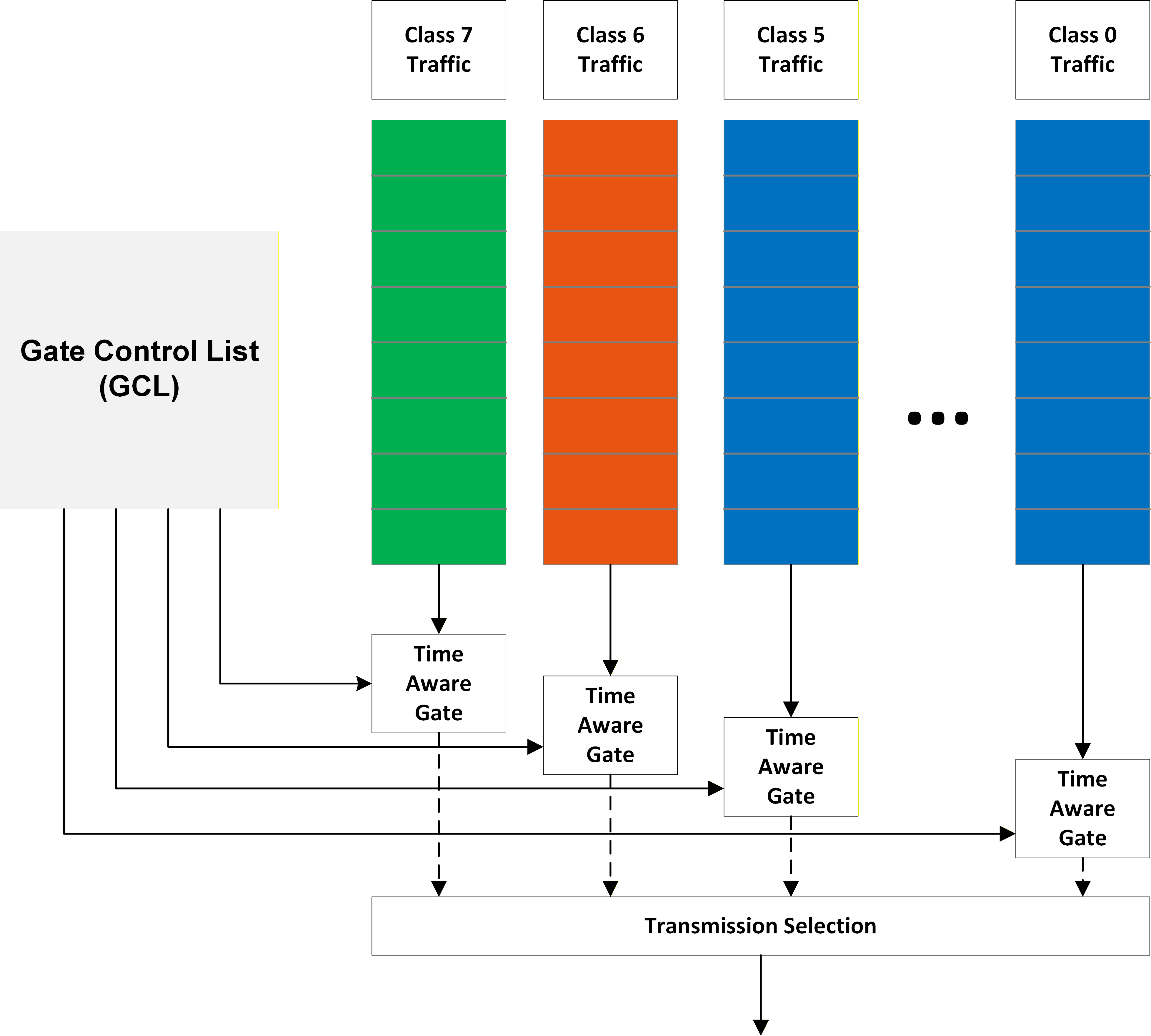
IEEE 802.1Qbv (Enhancements for Scheduled Traffic): is a crucial Time-Sensitive Networking (TSN) standard that provides “Enhancements for Scheduled Traffic” by adding a Time-Aware Shaper (TAS), allowing Ethernet switches to precisely schedule when different traffic types are sent, ensuring predictable, ultra-low latency for critical applications like industrial automation, robotics, and automotive systems, using a Gate Control List (GCL) to control queues based on precise timing.
Key Concepts of 802.1Qbv:
- Time-Aware Shaper (TAS): A mechanism within Ethernet switches that controls egress (output) queues, opening and closing them at exact times.
- Gate Control List (GCL): A pre-defined schedule that dictates when each queue is open (enabled) or closed (blocked) for frame transmission, ensuring traffic isolation and determinism.
- Time-Triggered Communication: Enables communication to happen at precisely scheduled intervals, making network behaviour predictable.
- Synchronisation: Relies on timing derived from other standards like IEEE 802.1AS (Precision Time Protocol – PTP) for accurate time synchronisation across the network.
IEEE 802.1Qci (Per-Stream Filtering and Policing, PSFP) is an amendment to the IEEE 802.1Q standard that enhances network security and reliability within Time-Sensitive Networking (TSN) environments by providing stream-specific ingress filtering and rate policing at the port level.
Key Functions of IEEE 802.1Qci
- Per-Stream Identification: It uses a set of rules (e.g., source/destination MAC addresses, VLAN IDs, priority codes) to uniquely identify individual data streams (flows) as they enter a network port.
- Filtering: Frames that do not match the expected criteria for a recognised stream are filtered out (dropped) immediately at the ingress port, preventing them from consuming network resources further along the path.
- Policing (Rate Limiting): The standard employs a “metering” function, typically using the token bucket algorithm, to enforce the negotiated bandwidth limits for each individual stream. Frames that exceed the allocated rate might be dropped or re-marked to a lower priority, ensuring a misbehaving stream does not cause congestion for other critical traffic.
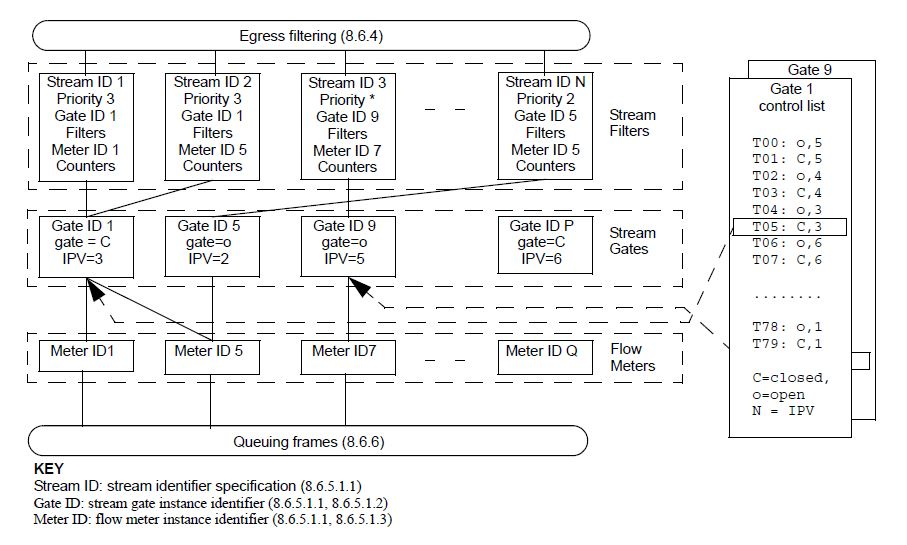
Per-Stream Filtering and Policing
IEEE 802.1Qbu (Frame Preemption) and IEEE 802.3br (Interspersing Express Traffic or IET) are two coordinated standards that work together to implement frame preemption in Time-Sensitive Networking (TSN). Their purpose is to reduce the latency of high-priority, time-critical traffic by allowing it to interrupt the ongoing transmission of lower-priority, best-effort traffic.
Key Functions
Interruption of Low-Priority Frames: The key innovation is the ability to pause the transmission of a large, low-priority (preemptable) Ethernet frame once a high-priority (express) frame becomes ready to send. In standard Ethernet, a frame transmission cannot be interrupted once started.
Prioritisation of Express Traffic: The express frame is transmitted immediately after a small portion (typically in 64-byte intervals) of the preemptable frame has been sent.
Resumption and Reassembly: Once the express frame completes transmission, the remaining fragments of the original preemptable frame are sent to the next switch in the path. The receiving switch reassembles all the fragments into the original data frame.
Reduced Latency and Guard Bands: This preemption drastically reduces the maximum time a high-priority frame has to wait (blocking time) for a large, non-critical frame to finish. When used with 802.1Qbv Time-Aware Shaping, preemption allows for much smaller “guard bands” (idle periods), which increases the overall bandwidth utilisation of the network.
TSN-Reliability and Redundancy
IEEE 802.1CB (Frame Replication and Elimination for Reliability): Sends duplicate copies of critical data frames over multiple independent network paths. The receiver accepts the first frame and discards duplicates, providing seamless redundancy and preventing data loss.
1. Frame Preparation and Replication (Source)
- Stream Identification: A “talker” (sending device) identifies a critical data stream that requires reliability guarantees.
- Sequence Numbering: The talker (or the first bridge with FRER capability) adds an R-tag to each frame, which includes a unique sequence number.
- Replication: The talker or a designated “replication function” in a bridge creates multiple, identical copies (replicas) of the frame.
- Redundant Transmission: Each replica is then forwarded into separate, independent network paths (member streams) simultaneously. The standard specifies the procedures for this, but does not define how to create the physical paths themselves, which requires network engineering to ensure disjoint routes.
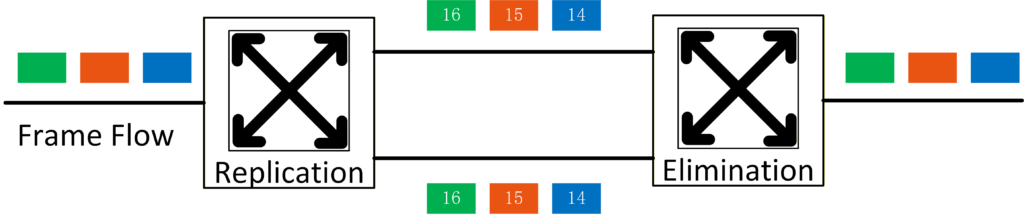
Frame Replication and Elimination for Reliability
2. Redundant Transmission (Relays)
- The duplicate frames travel through the network along their respective paths.
- Standard bridges in the network forward these frames as usual.
- If a link or a bridge along one path fails, the frames on that specific path might be lost or delayed, but the copies on the other paths continue their journey.5
3. Elimination and Reconstitution (Destination)
- A “listener” (receiving device) or a designated “elimination function” in a bridge receives the incoming member streams.
- Duplicate Detection: The receiver uses the sequence number in the R-tag of each arriving frame to identify duplicates.
- Elimination: The first valid frame of a specific sequence number is accepted and passed up to the receiving application. All subsequent frames with that same sequence number that arrive later are discarded (eliminated).
- Reordering (Implicit): Because the receiver processes frames based on their sequence number, the original frame order is effectively restored, regardless of which physical path was faster or slower.
- Timeout/Reset: The elimination function maintains a history of received sequence numbers for a certain period. A timer is used to manage the sequence history and handle cases where frames are permanently lost, or the sequence needs to be reset due to a prolonged fault.
TSN-Configuration and Management
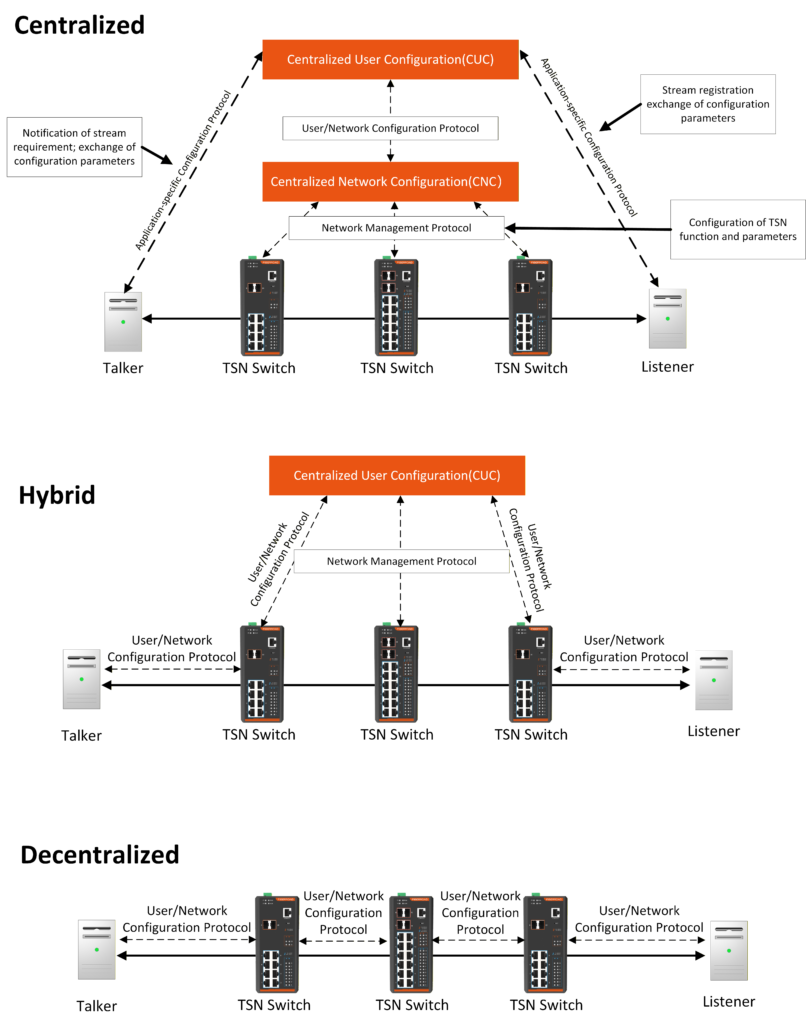
IEEE 802.1Qcc is a Time-Sensitive Networking (TSN) standard that defines enhancements to the Stream Reservation Protocol (SRP) to support scalable and flexible configuration of time-sensitive data streams. It is crucial for managing resource allocation in complex, dynamic industrial and automotive networks.
Key Enhancements and Features
Centralized Configuration: The standard defines roles for centralized management entities:
- Centralized Network Configuration (CNC): This entity has a global view of the entire network topology and all streams. It is responsible for calculating optimal routes, performing resource allocation and admission control, and generating precise schedules for features like the Time-Aware Shaper (IEEE 802.1Qbv).
- Centralized User Configuration (CUC): This optional entity sits above the CNC and discovers end stations, their capabilities, and application requirements, which it then passes to the CNC for configuration.
Scalability and Performance: The centralized approach improves performance in large-scale networks by reducing the amount of signaling traffic that would otherwise be propagated bridge-by-bridge in a fully distributed model.
Support for Diverse Traffic Types: It allows for the configuration of a wider range of TSN features and traffic shapers beyond the original Credit-Based Shaper (IEEE 802.1Qav) used in AVB, including scheduled traffic (IEEE 802.1Qbv) and frame preemption (IEEE 802.1Qbu/802.3br).